
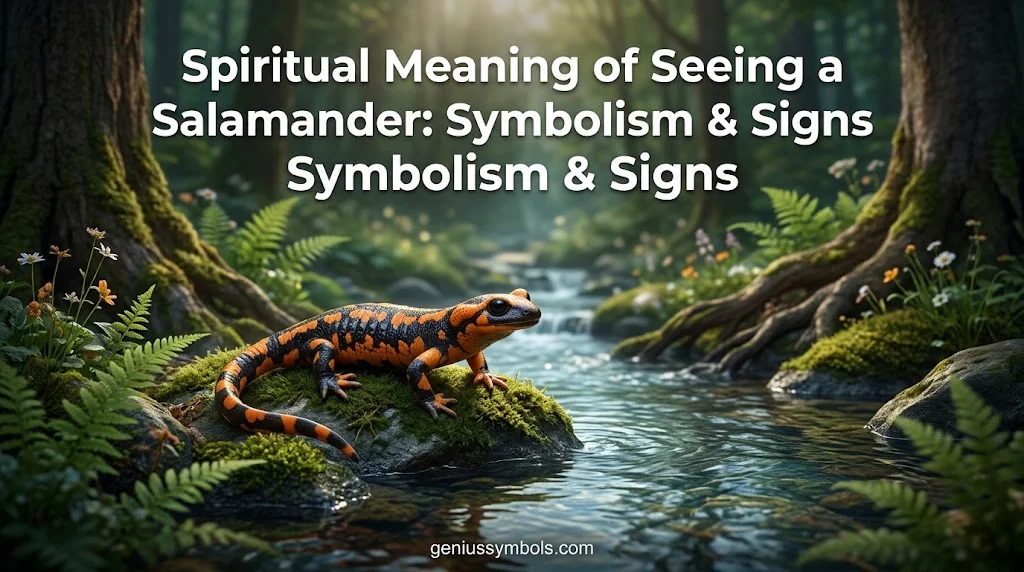
The Spiritual Meaning of Seeing a Salamander is often connected to transformation, emotional renewal, hidden strength, and the ability to overcome difficult situations. This small amphibian carries powerful symbolism because of its unusual connection to water, land, and ancient stories about fire. Its appearance can encourage you to welcome change and recognize your inner strength.
In American culture, salamanders are associated with nature, regeneration, survival, and environmental balance. Their ability to regrow certain body parts has also made them powerful symbols of recovery and fresh beginnings. Additionally, ancient European traditions connected salamanders with fire and the ability to survive intense heat.
However, seeing a salamander doesn’t have one universal spiritual interpretation. Its meaning may depend on where you encounter it, what it looks like, and how you feel at that moment. Some people view the encounter as a reminder to stay strong, while others associate it with personal growth and emotional healing.
Quick Answer
The spiritual meaning of seeing a salamander in the USA commonly represents resilience, transformation, renewal, and hidden strength. Spiritually, it can also symbolize surviving difficult experiences, adapting to change, and discovering opportunities for personal growth.
TL;DR
- Transformation: A salamander represents personal change and new beginnings.
- Resilience: It symbolizes surviving challenges without losing your inner strength.
- Renewal: Its regenerative abilities connect it with recovery and restoration.
- Protection: Its secretive nature represents boundaries and personal safety.
- Adaptability: Its connection to water and land symbolizes flexibility.
- Spiritual growth: Its ancient fire symbolism represents purification and inner development.
1. Overview of Salamander Symbolism
A salamander is a small amphibian with a long body, four limbs, and a distinctive tail. Although it sometimes resembles a lizard, it has smooth, moist skin and belongs to a different animal group.
Salamanders come in different colors, including black, brown, yellow, red, orange, and spotted combinations. These physical differences create several symbolic associations in modern spiritual interpretations.
What Does a Salamander Represent?
Today, salamanders commonly represent several qualities:
- Transformation: Moving through important life changes.
- Regeneration: Recovering after difficult experiences.
- Endurance: Maintaining strength during challenging periods.
- Adaptability: Adjusting to unfamiliar situations.
- Hidden wisdom: Recognizing lessons that aren’t immediately obvious.
- Protection: Understanding when to remain private or cautious.
These meanings come from the animal’s natural characteristics and historical associations. However, they aren’t universal spiritual rules.
Why Is the Salamander Considered Special?
Salamanders have an unusual ability to regenerate certain body parts. Depending on the species, they can regrow tails, limbs, and other tissues.
This natural ability makes them powerful symbols of restoration. Furthermore, their dependence on damp environments connects them with water, emotional sensitivity, and the natural cycles of life.
Their ancient association with fire adds another layer of meaning. Together, these qualities create a symbol of survival and transformation.
2. Spiritual Meaning of Seeing a Salamander
Seeing a salamander can inspire reflection about your current circumstances. Its symbolism often focuses on personal strength, emotional changes, and the importance of adapting.
In contemporary spiritual interpretations, the encounter may encourage you to pay attention to areas of life that need renewal.
A Sign of Personal Transformation
A salamander can symbolize a period of personal transformation. You might be leaving behind old habits, changing your priorities, or developing a different understanding of yourself.
For example, starting a new career or rebuilding a relationship may require emotional flexibility. The salamander represents the ability to move forward without allowing previous experiences to define you.
A Reminder of Inner Strength
Sometimes, people associate salamander sightings with hidden strength.
You may feel uncertain about your abilities or overwhelmed by recent challenges. However, this symbol can encourage you to recognize the strength you’ve already developed.
- Trust your ability to handle unfamiliar situations.
- Learn from experiences instead of remaining trapped in them.
- Give yourself time to recover from setbacks.
- Recognize progress even when it seems small.
An Invitation to Welcome New Beginnings
A salamander may also represent the beginning of a different chapter. Its regenerative abilities provide a natural connection with restoration and fresh opportunities.
Rather than rushing into something new, consider what needs attention first. Sometimes, meaningful progress begins with small changes.
3. Historical Origins of Salamander Symbolism
Salamander symbolism has roots in ancient Greek and Roman traditions. Early naturalists developed fascinating stories about this amphibian because of its unusual appearance and behavior.
Over time, these stories influenced European folklore, medieval religious imagery, and Renaissance symbolism.
Ancient Greek and Roman Beliefs
Ancient Greek writers described salamanders as extraordinary creatures connected to fire. Aristotle discussed the belief that salamanders could withstand flames and even extinguish them.
Later, Roman naturalist Pliny the Elder repeated and expanded similar claims. These beliefs probably developed because salamanders sometimes emerged from damp logs placed near fires.
People saw the animals escaping burning wood and misunderstood what was happening. Nevertheless, the story became an important part of ancient natural history.
Medieval European Symbolism
During the Middle Ages, the salamander became a symbol of endurance and purity.
Its supposed ability to survive fire made it an image of remaining strong during difficult experiences. Some Christian interpretations connected it with spiritual faith and resisting temptation.
However, not every historical interpretation was positive. Certain medieval stories also connected salamanders with dangerous or mysterious forces.
Renaissance and Alchemical Traditions
During the Renaissance, salamanders became strongly associated with the element of fire.
Alchemists used the creature to represent transformation, purification, and the changing nature of matter. Alchemy was an early tradition that combined ideas about nature, philosophy, and attempts to transform materials.
The salamander also appeared in European artwork and royal imagery. French King Francis I famously used a salamander as an emblem.
Historical note: The salamander’s connection with fire comes from folklore, not its actual biology.
4. Salamander Symbolism in the United States
In the United States, salamanders have a strong connection with wildlife, forests, freshwater habitats, and environmental awareness.
Unlike some European traditions, American interpretations often focus more on the animal’s real characteristics than its mythical relationship with fire.
Resilience and Survival
American readers frequently encounter salamanders as examples of survival and regeneration.
Their ability to recover from certain injuries makes them natural symbols of perseverance. They remind people that recovery can take time and that difficult experiences don’t always determine the future.
This interpretation is especially meaningful during periods of personal change.
Connection With American Nature
Salamanders are particularly important in the Appalachian region. This area contains more salamander species than anywhere else in the world.
Consequently, they have become important symbols of biodiversity and healthy forest ecosystems.
In American nature education, salamanders also represent the importance of protecting freshwater habitats and natural environments.
Common American Associations
| Context | Symbolic Meaning | Common Association |
| Personal growth | Transformation | Starting over |
| Nature | Balance | Healthy ecosystems |
| Difficult experiences | Resilience | Overcoming setbacks |
| Wildlife protection | Environmental awareness | Conservation |
| Spiritual artwork | Renewal | Inner strength |
These associations aren’t official national meanings. Instead, they reflect common themes found in contemporary American nature and spiritual culture.
5. Spiritual Meaning of Seeing a Salamander in Different Colors
A salamander’s color can influence how people interpret its symbolic appearance. Modern spiritual interpretations often connect different colors with particular emotions and qualities.
These associations are personal and symbolic rather than established meanings shared by every culture.
Black Salamander
A black salamander can represent mystery, protection, and hidden strength.
Black is often associated with the unknown and the parts of life that remain unexplored. Seeing one may encourage you to examine your fears and develop stronger personal boundaries.
It can also symbolize quiet confidence during uncertain situations.
Red salamanders are often associated with passion, courage, and determination.
The color red traditionally represents energy, movement, and strong emotions. Spiritually, seeing one may encourage you to reconnect with your motivation.
It can also symbolize the courage needed to make an important decision.
A yellow salamander can symbolize optimism, awareness, and intellectual growth.
Yellow is commonly associated with sunlight, happiness, and fresh ideas. Its appearance may remind you to approach challenges with a more positive outlook.
It can also represent confidence in your abilities.
Orange is often connected with creativity, enthusiasm, and emotional warmth.
Seeing an orange salamander may represent renewed motivation. It can also encourage you to explore creative interests or reconnect with activities that bring happiness.
Brown represents stability, grounding, and connection with nature.
A brown salamander may symbolize the importance of building a stable foundation. It can remind you to focus on practical needs rather than becoming overwhelmed by uncertainty.
6. Cross-Cultural and Spiritual Meanings of Salamanders
Salamanders have appeared in different cultural traditions, although their meanings aren’t identical everywhere.
Some interpretations developed from real observations of amphibians. Others emerged from mythology, religious stories, and symbolic systems.
European Spiritual Traditions
European folklore strongly connected salamanders with fire.
During medieval and Renaissance periods, the animal represented endurance under pressure. Its supposed ability to survive flames became an image of strength during difficult circumstances.
Later, alchemical traditions used it as a symbol of transformation and purification.
Jewish Folklore
Some Jewish religious and folkloric writings describe a remarkable salamander associated with fire.
In particular, rabbinic stories discuss a creature believed to originate in fire and possess protection against flames. These accounts belong to traditional religious literature rather than modern zoology.
Its symbolism includes protection and extraordinary endurance.
East Asian Cultural Connections
In Japan, the giant salamander has a place in traditional folklore and regional cultural history.
The Japanese giant salamander is a real, large aquatic amphibian. Its unusual appearance has inspired stories and local associations with mysterious freshwater environments.
However, specific spiritual meanings should not be treated as universal Japanese beliefs.
Modern Spiritual Interpretations
Contemporary spiritual writers often connect salamanders with:
- Renewal after difficult experiences.
- Transformation through personal challenges.
- Emotional flexibility and sensitivity.
- Protection during uncertain periods.
- Balance between different areas of life.
These interpretations are modern symbolic readings, not established teachings shared by all spiritual traditions.
Read More: Spiritual Meaning of Hippopotamus in Dreams: What It Reveals
7. Emotional and Psychological Meaning of Seeing a Salamander
Animals can become meaningful personal symbols because their appearance reminds us of particular experiences, feelings, or memories.
From a psychological perspective, seeing a salamander may encourage reflection on your emotional condition.
Learning to Adapt
Salamanders live in environments where moisture and temperature matter greatly.
Their sensitivity to surroundings can represent the importance of recognizing changes in your own environment. For example, you might need to adjust your expectations when entering a new workplace or relationship.
The symbolism encourages flexibility without losing your sense of identity.
Understanding Hidden Emotions
Because salamanders often remain beneath rocks, logs, and leaves, they can symbolize emotions that aren’t immediately visible.
You may be keeping your worries private or avoiding conversations that feel uncomfortable.
Seeing one can serve as a personal reminder to understand your feelings rather than ignore them.
Building Emotional Resilience
The salamander’s regenerative abilities create a strong connection with recovery.
You might be working through disappointment, grief, or uncertainty. Its symbolism can encourage patience while you rebuild confidence.
Remember that recovery doesn’t always happen quickly. Small steps can still represent meaningful progress.
8. Spiritual Meaning of Seeing a Salamander in Different Places
Where you encounter a salamander can influence your personal interpretation.
The surrounding environment provides useful context because different locations carry different natural and symbolic associations.
Seeing a Salamander in Your House
Finding a salamander inside your house may symbolize the need for personal awareness and emotional balance.
In contemporary spiritual interpretations, a home represents security, privacy, and family life. Therefore, the encounter may encourage you to pay attention to your surroundings.
However, salamanders sometimes enter buildings through damp areas or small openings. Their presence doesn’t automatically indicate a supernatural event.
Seeing a Salamander Outside
An outdoor sighting can represent a connection with nature and personal freedom.
It may encourage you to spend more time appreciating your environment. It can also symbolize the importance of allowing personal growth to happen naturally.
Water is commonly associated with emotions, cleansing, and renewal.
Therefore, seeing a salamander near water may represent emotional awareness and the need to reconnect with your feelings.
It can also symbolize a fresh perspective after a difficult period.
Seeing a Salamander After Rain
Rain often symbolizes cleansing, nourishment, and fresh beginnings.
Because many salamanders become more active in moist conditions, seeing one after rainfall has a natural explanation.
Symbolically, you might interpret the encounter as an opportunity to begin again or welcome a more supportive period.
9. Spiritual Meaning of Seeing a Salamander Repeatedly
Repeated salamander sightings may attract your attention, especially when they happen during important personal changes.
However, repeated encounters don’t automatically prove that the universe is sending a specific message. Environmental conditions and the animal’s natural habitat may explain them.
A Reminder to Notice Personal Changes
If you repeatedly encounter salamanders, consider whether your life is going through a period of transition.
You might be changing your habits, relationships, or long-term priorities. The salamander can become a personal reminder to approach these changes with patience.
Recognizing Patterns in Your Life
Repeated encounters can also encourage self-reflection.
Consider these questions:
- Are you avoiding an important change?
- Have you recently recovered from a difficult experience?
- Are you protecting your emotional boundaries?
- Do you need more time to understand your feelings?
- Are you developing confidence in a new situation?
Your answers may help you understand why the encounter feels meaningful.
10. Salamander as a Spirit Animal and Symbol of Protection
In contemporary spiritual writing, the salamander is sometimes described as a spirit animal associated with resilience and transformation.
However, terminology such as spirit animal and totem has specific cultural histories. These terms shouldn’t be treated as interchangeable with every modern animal-symbol interpretation.
Salamander as a Symbol of Inner Protection
The salamander’s secretive behavior can represent the importance of protecting your personal space.
You don’t need to share every plan, emotion, or decision with everyone. Sometimes, privacy provides room for personal development.
Its symbolism may encourage you to establish healthy boundaries.
Salamander as a Symbol of Courage
Its historical association with fire gives the salamander another powerful meaning.
It can represent the courage to face uncomfortable situations without abandoning your values.
This doesn’t mean ignoring danger or forcing yourself through every challenge. Instead, it suggests recognizing when you have the strength to move forward.
Lessons Associated With Salamander Symbolism
- Protect your energy and personal boundaries.
- Accept that growth requires patience.
- Remain flexible when circumstances change.
- Learn from experiences instead of fearing them.
- Allow yourself time to recover and rebuild.
11. Salamander Tattoos, Art, and Modern Popular Culture
Salamander imagery has become a popular subject in fantasy artwork, nature illustrations, decorative designs, and symbolic tattoos.
Its unusual appearance makes it suitable for both realistic and imaginative artistic styles.
A salamander tattoo can represent several personal values.
- Resilience: Surviving difficult experiences.
- Transformation: Embracing a new chapter.
- Renewal: Recovering and rebuilding confidence.
- Courage: Facing challenges with determination.
- Connection with nature: Appreciating wildlife and natural environments.
Some people choose realistic salamander designs, while others prefer mythical creatures surrounded by flames.
Salamanders in Home Decor
Salamander artwork can add natural and symbolic elements to interior spaces.
Common decorative choices include wooden carvings, nature-inspired illustrations, ceramic figures, and fantasy-style designs.
A fire salamander illustration may emphasize transformation, while a realistic woodland salamander can represent a connection with nature.
Salamanders on Social Media
On social media, salamander images sometimes appear alongside messages about personal growth, unusual wildlife, and spiritual transformation.
People may use the animal as a reminder that meaningful change can happen quietly.
Its unusual appearance also makes it interesting for educational wildlife content and nature photography.
12. Misunderstandings and Controversies About Salamander Symbolism
Salamanders have several symbolic associations, but not every popular interpretation comes from historical or scientific evidence.
Understanding these differences helps readers appreciate the animal without confusing mythology with reality.
Mythical Fire Resistance
One common misunderstanding is that real salamanders can live inside burning flames.
This belief comes from ancient folklore. In reality, salamanders need suitable moisture and temperatures to survive.
Their appearance in burning logs probably helped create the old story.
Salamanders Are Not Lizards
Although salamanders resemble small lizards, they are amphibians.
They don’t have the dry, scaly skin associated with reptiles. Many species also depend on moist environments and have special breathing adaptations.
Regeneration Doesn’t Mean Complete Immortality
Salamanders can regenerate certain body parts, but this ability doesn’t make them immortal.
Different species have different regenerative abilities. Their recovery also depends on biological conditions and the type of injury.
Spiritual Interpretations Aren’t Universal Facts
Some websites describe salamanders as signs of immediate good fortune, divine protection, or guaranteed personal transformation.
These are interpretations rather than established facts.
A salamander sighting doesn’t predict a specific future event. Its symbolism is most useful when approached as a personal reflection rather than an unquestionable message.
13. How Salamander Symbolism Has Changed Over Time
The salamander’s symbolic meaning has changed considerably throughout history.
Ancient people viewed it through the lens of mythology and early natural history. Medieval writers developed religious interpretations, while Renaissance thinkers connected it with alchemy.
Today, modern interpretations often combine historical stories with the animal’s actual biological characteristics.
From Fire Myth to Natural Regeneration
The older fire association remains one of the salamander’s most recognizable symbolic features.
However, modern readers increasingly connect it with regeneration and adaptability.
Its ability to regrow certain body parts provides a real-world foundation for these interpretations.
From Religious Imagery to Personal Symbolism
In earlier European traditions, salamanders sometimes represented faith, purity, and spiritual endurance.
Today, people also use the image to express individuality, creativity, personal recovery, and environmental awareness.
Why Its Meaning Still Matters
The salamander remains interesting because its symbolism brings together seemingly opposite qualities.
It is a small, vulnerable animal associated with powerful mythical stories. It depends on delicate environmental conditions yet can regenerate certain damaged body parts.
That contrast makes it a lasting image of survival, flexibility, and renewal.
FAQs
1. Is seeing a salamander a good spiritual sign?
Many contemporary spiritual interpretations consider salamanders positive symbols of renewal, resilience, and transformation. However, the meaning depends on your personal beliefs and the circumstances surrounding the encounter.
2. What does a salamander symbolize spiritually?
A salamander commonly symbolizes regeneration, adaptability, protection, and inner strength. Its historical connection with fire also represents purification and transformation.
3. What does it mean when a salamander crosses your path?
A salamander crossing your path can serve as a personal reminder to remain flexible during changes. Some people interpret the encounter as encouragement to move forward with patience and confidence.
4. What does a black salamander mean spiritually?
A black salamander is often associated with mystery, protection, and hidden strength. Its dark color can symbolize unexplored feelings and the importance of personal boundaries.
5. What does seeing a salamander in your house mean?
Spiritually, seeing a salamander inside your home may represent emotional awareness, protection, and changes within your personal life. Naturally, it may have entered through a damp area or small opening.
Conclusion
The Spiritual Meaning of Seeing a Salamander is closely associated with transformation, resilience, regeneration, and adaptability. Its unusual connection with ancient fire mythology and its real ability to regenerate certain body parts make it a fascinating symbol across different traditions.
In American culture, salamanders also represent the importance of wildlife, environmental balance, and survival. Their appearance may encourage you to recognize your inner strength, protect your personal boundaries, and remain open to new experiences.
