
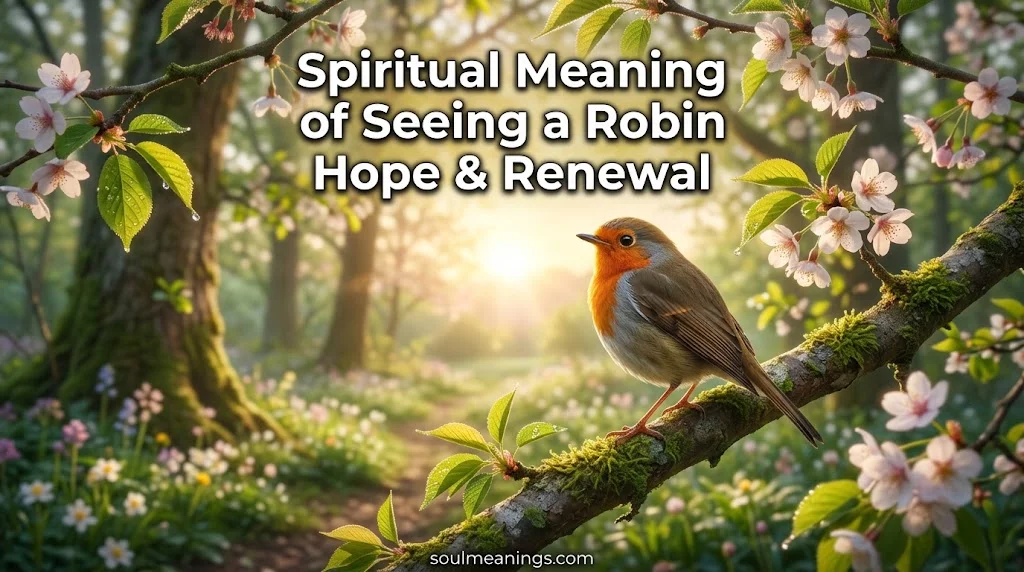
The phrase ” Seeing a Robin Hope & Renewal connects a robin with spring, new beginnings, rebirth, joy, comfort, and a personal sense of hope. When a robin appears near you, this small red-breast bird can become a symbol of a new beginning, re-birth, and renewed life. Its song and arrival, along with the bright color of a red robin, may suggest good fortune, happiness, and passion.
I find the symbolism especially interesting because a cheerful presence can make an ordinary moment feel meaningful. Vibrant red chests, singing, and inquisitive personalities make these well-known birds memorable, while the robin symbolism meaning can remain ambiguous because its symbolic significance differs between cultures and personal beliefs.
The same Robin symbolism may also relate to death, the afterlife, spirits, and deceased loved ones. Some personal testimonies describe a robin that visits you during an emotional or meaningful moment, creating a sense of spiritual meaning. In Christianity, the robin has played an important role in certain stories and traditions associated with divine sacrifice, while superstitions may give the animal different meanings.
Quick Answer
The Spiritual Meaning of Seeing a Robin in the USA is most often linked with renewal, hope, new beginnings, and joy. Some people also interpret a robin as a comforting reminder of someone who has passed away, while other traditions connect the bird with courage, protection, or seasonal change.
TL;DR
- Robins commonly symbolize renewal, hope, and fresh beginnings.
- Americans strongly associate robins with spring and warmer weather.
- Some people see robin visits as comforting signs after loss.
- Indigenous traditions give the bird different meanings in specific communities.
- Robin symbolism also appears in tattoos, art, decor, and social media.
- A robin’s spiritual meaning remains personal rather than scientifically proven.
What Does Seeing a Robin Symbolize?
Seeing a robin can feel significant because the bird has become deeply familiar in American life. Its orange-red chest, dark head, upright posture, and lively movements make it easy to recognize.
More importantly, its seasonal behavior has shaped its symbolism. In many northern parts of the United States, people notice robins when lawns become visible and winter begins to loosen its grip.
The Main Symbolic Meanings
A robin is commonly associated with:
- Renewal after a difficult or inactive period
- Hope when circumstances begin to improve
- New beginnings and personal transformation
- Joy expressed through song and movement
- Growth during important life transitions
- Comfort during periods of grief or remembrance
These meanings aren’t fixed rules. Instead, they provide a symbolic language people use to understand an ordinary encounter with nature.
Why the Robin Feels So Positive
The robin’s symbolism comes partly from what people observe. It searches openly for food, sings during the day, raises young, and adapts well to human environments.
Therefore, the bird can represent a practical kind of hope. It doesn’t suggest that life will always be easy. Instead, it reflects the idea that life continues and changes.
Is Seeing a Robin a Sign of Spring?
For many Americans, the robin is one of the strongest traditional signs of spring. Its appearance on lawns after winter has become part of American seasonal culture.
However, the idea needs a small qualification. American robins don’t all disappear during winter. Some remain in the same general region throughout the year.
Why Robins Became Spring Symbols
When temperatures rise, robins become much more noticeable in many areas. They return to open lawns, feed actively, establish territories, and begin nesting.
That visible change creates a powerful seasonal image:
Winter → return of life → spring → growth
The robin therefore became a natural symbol of starting again.
What the Robin Can Represent
For a person going through a difficult period, seeing a robin may feel like a personal version of spring.
It can symbolize:
- Leaving an old chapter behind
- Beginning something you’ve delayed
- Recovering confidence after hardship
- Becoming open to unexpected opportunities
- Trusting that difficult seasons can change
The bird doesn’t predict these events. Instead, it gives people a meaningful image for them.
What Is the Historical Meaning of the Robin?
Robin symbolism has a long and complicated history because American robins and European robins are different birds.
The American robin is Turdus migratorius, a member of the thrush family. The European robin, Erithacus rubecula, belongs to a different family.
The American Robin in North America
European settlers gave the American bird the familiar name “robin” because its reddish breast reminded them of the European robin.
That naming decision helped transfer some older ideas about robins to North America. Yet the American robin developed its own identity through American landscapes, literature, folklore, and everyday experience.
The bird eventually became especially connected with spring.
The Robin in American Literature
American writers and poets helped strengthen the bird’s seasonal image. Nineteenth-century writing frequently used the first robin as a sign of changing weather and returning life.
Emily Dickinson’s poem “I Dreaded That First Robin So” is one well-known example of how the bird entered American literary culture.
The robin also appeared in songs, children’s stories, artwork, and everyday sayings. Over time, its meaning became less mysterious and more connected to the familiar rhythm of American seasons.
What Does a Robin Mean Spiritually in the USA?
In modern American spirituality, the robin usually carries a positive message. People often connect it with renewal, emotional healing, courage, and the beginning of a better chapter.
However, American spiritual beliefs aren’t one single tradition. Different people interpret the same bird through Christianity, Indigenous traditions, personal spirituality, folklore, or secular ideas about nature.
Common Modern Interpretations
| Context | Meaning in the USA | Common Association | Important Note |
| Spring sighting | Renewal | Fresh starts | Strong seasonal tradition |
| After hardship | Hope | Resilience | Personal interpretation |
| During grief | Comfort | Remembrance | Spiritual belief, not proof |
| Near the home | Familiarity | Peace and belonging | Often simply habitat behavior |
| Robin song | Joy | Expression and optimism | Also serves biological purposes |
| Robin tattoo | Transformation | Growth and memory | Meaning depends on design |
The strongest modern interpretation is usually renewal. The robin’s connection with spring makes that meaning especially easy to understand.
Does a Robin Symbolize a Loved One Who Passed Away?
For some people, seeing a robin after someone’s death feels like a message from that person. This belief has become especially popular in modern spiritual and grief-related discussions.
The phrase “when robins appear, loved ones are near” is often shared online and in memorial settings. However, it should be understood as a comforting belief rather than an established fact.
Why People Find This Meaning Comforting
Grief can make ordinary moments feel deeply meaningful. A familiar bird appearing at an emotionally important time can create a powerful sense of connection.
For someone who has lost a parent, partner, friend, or other loved one, a robin may become a personal symbol of remembrance.
The meaning might be as simple as:
“This reminds me of someone I love.”
That interpretation can be meaningful without claiming that every robin carries a supernatural message.
Robin vs. Cardinal Symbolism
In the United States, the cardinal has a particularly strong modern association with deceased loved ones. Robins can carry a similar meaning for some people, but the tradition is less consistent.
Therefore, it’s better to say that robin visitation symbolism is personal and modern, rather than presenting it as a universal American belief.
What Does a Robin Mean in Indigenous Traditions?
Indigenous cultures should never be treated as one single belief system. Different nations have distinct languages, histories, ceremonies, and relationships with animals.
Some North American traditions contain robin stories involving fire, protection, courage, seasonal change, or community life. These stories should be connected to their specific communities rather than generalized to every Indigenous nation.
Stories About the Robin’s Red Breast
Some Indigenous traditions explain the robin’s reddish breast through stories involving fire. In versions associated with particular communities, the bird’s actions around fire help explain why its chest has its distinctive color.
These stories aren’t scientific explanations of feathers. Instead, they are cultural narratives that give a visible feature a deeper meaning.
Why Cultural Context Matters
Online symbolism often combines traditions from unrelated nations. That can create misleading claims such as saying that “Native Americans believe robins mean one specific thing.”
A more accurate approach recognizes diversity.
The robin may represent one idea in one community and something different elsewhere. Respectful symbolism keeps those distinctions clear.
What Does the Robin Mean in Christian Symbolism?
The robin has a place in Christian folklore, particularly through European traditions involving its red breast. One popular legend connects the bird’s color with compassion shown during the Crucifixion.
According to the story, the robin tried to help Christ and received a red mark on its breast.
Compassion and Sacrifice
Because of this legend, the European robin became associated with compassion, sacrifice, and kindness.
However, this is folklore rather than a biblical teaching. The Bible doesn’t identify the robin as a sacred symbol or assign it a spiritual meaning.
This distinction matters because modern articles sometimes present later folklore as if it were direct biblical doctrine.
How the Meaning Reached America
European settlers brought many stories about robins to North America. Some ideas later became attached to the American robin because of its similar appearance.
Still, the American bird’s strongest American symbolism developed around spring, familiarity, and renewal.
Read More: Spiritual Meaning of Seeing a White Squirrel
What Does Seeing a Robin Mean Emotionally?
A robin can carry emotional meaning because humans naturally connect visual experiences with memories and feelings.
Its appearance may bring back childhood memories of spring, time spent outdoors, family traditions, or someone who loved watching birds.
Emotional Associations
People commonly connect robins with:
- Hope after difficult experiences
- Comfort during periods of sadness
- Joy through birdsong and nature
- Courage when starting over
- Peace during quiet outdoor moments
- Belonging through familiar backyard wildlife
These associations can influence how someone experiences a robin encounter.
The Psychology of Personal Symbolism
A symbol becomes especially powerful when it connects with an existing emotion.
For example, someone starting a new career might see a robin and think about fresh opportunities. Someone grieving might associate the same bird with a lost family member.
The bird hasn’t changed. The personal context has.
That is one reason symbolism can feel deeply meaningful without requiring a supernatural explanation.
What Does It Mean When a Robin Visits Your Yard?
A robin visiting your yard can have both an ordinary explanation and a symbolic interpretation.
From a natural perspective, your yard may provide food, water, shelter, open ground, or nesting opportunities. Robins commonly use gardens, parks, lawns, and urban spaces.
Spiritual Interpretations
Symbolically, a robin in your yard can represent:
- A fresh chapter beginning close to home
- A reminder to notice everyday beauty
- Emotional renewal after a difficult period
- A feeling of protection or familiarity
- Encouragement to reconnect with nature
- Hope entering an ordinary part of life
The most useful interpretation depends on what the encounter means to you.
If the Robin Returns Repeatedly
Repeated sightings can feel especially meaningful.
Before assuming a spiritual cause, notice the practical reasons. Your yard may have fruiting plants, moist soil, insects, nesting areas, or other resources that attract robins.
You can still appreciate the symbolic meaning. The natural explanation and personal interpretation don’t have to compete.
What Does a Robin Mean in Dreams?
A robin in a dream is often interpreted through the same themes of renewal, freedom, hope, and emotional change.
Dream symbolism isn’t universal, though. The details surrounding the bird matter.
Common Dream Interpretations
A robin singing might suggest joy, communication, or optimism.
A robin building a nest may symbolize creating stability, family, or a new life chapter.
A robin flying away might represent change, release, or letting go.
A robin appearing after a period of sadness may reflect your mind processing memories, hope, or emotional recovery.
Rather than relying on a fixed dream dictionary, consider what the robin means to you.
How Is Robin Symbolism Used Today?
Robin symbolism remains visible in everyday American culture. The bird appears in artwork, greeting cards, children’s books, garden decorations, seasonal products, tattoos, and social media posts.
Its recognizable shape makes it easy to use as a simple visual symbol.
Robin Tattoos
A robin tattoo can represent:
- A new beginning after hardship
- A tribute to someone remembered
- Love of nature and wildlife
- Personal resilience
- Spring and transformation
- Family, home, or childhood memories
Design details can change the message. Flowers may emphasize renewal, while a date or name can make the tattoo memorial-focused.
Home Decor and Art
Robin images often appear in spring decorations and nature-themed artwork.
A robin on a branch can create a peaceful feeling. Meanwhile, a robin surrounded by flowers strongly emphasizes growth and seasonal renewal.
Social Media
On social platforms, people sometimes share robin photographs during emotional milestones.
Captions may connect the bird with hope, someone who has died, a new beginning, or simply the arrival of spring.
Because these meanings spread quickly online, modern folklore can become popular even when its historical roots are recent.
Are There Negative Meanings or Misunderstandings?
Most American robin symbolism is positive. However, several misunderstandings have developed because people combine different robin traditions.
One major mistake is treating every robin story as if it refers to the same bird.
American Robin vs. European Robin
The two birds have different scientific classifications and different cultural histories.
European traditions contain many stories about the European robin. Meanwhile, American culture developed its own strong connection between the American robin and spring.
This distinction helps explain why some spiritual claims appear contradictory.
Is a Robin Always a Supernatural Sign?
No.
A robin can simply be a robin. It may be searching for food, defending territory, finding a mate, or caring for young.
Spiritual symbolism describes human interpretation, not a proven supernatural process.
Can Seeing a Robin Predict the Future?
There is no reliable scientific evidence that robin sightings predict specific future events.
You can still treat a sighting as a personal reminder. For example, you might use it as a cue to embrace change or appreciate the present.
That approach keeps the symbolism meaningful without turning folklore into certainty.
How Has Robin Symbolism Changed Over Time?
Robin symbolism has shifted as the bird moved through different cultural settings.
Older European traditions gave the robin religious and folkloric meanings. American culture increasingly emphasized its role as a familiar backyard bird and sign of spring.
From Folklore to Personal Spirituality
Earlier traditions often gave animals shared cultural meanings. Today, people increasingly create personal interpretations.
A robin might represent:
Spring → renewal → healing → remembrance → personal hope
This chain shows how older seasonal symbolism can become an individual spiritual experience.
What Remains Consistent?
Despite these changes, several themes remain remarkably stable.
Hope, renewal, seasonal change, courage, and emotional comfort continue to appear in modern robin symbolism.
The details change, but the central idea remains simple: life can begin again.
FAQs:
What does it mean when you see a robin?
Seeing a robin is commonly interpreted as a sign of hope, renewal, and new beginnings. In the United States, its strong connection with spring makes it an especially familiar symbol of positive change.
Is seeing a robin good luck?
Many folklore traditions associate robins with good luck or favorable change. In modern American symbolism, the bird is generally viewed positively, especially because of its connection with spring.
Do robins symbolize loved ones who have passed away?
Some people believe a robin can serve as a comforting reminder of a deceased loved one. This is a personal spiritual belief, not something that can be scientifically confirmed.
What does a robin symbolize spiritually?
A robin commonly symbolizes renewal, hope, growth, courage, and fresh beginnings. Some people also connect it with comfort, remembrance, and emotional healing.
What does it mean when a robin visits your home?
Symbolically, a robin near your home may represent renewal, peace, or a new chapter. Naturally, your property may simply provide food, shelter, nesting space, or suitable ground for feeding.
What does a robin symbolize in Christianity?
European Christian folklore sometimes connects the robin’s red breast with compassion and sacrifice. However, this story is folklore and isn’t a biblical teaching about the bird.
Conclusion:
The Spiritual Meaning of Seeing a Robin is most strongly connected with hope, renewal, new beginnings, and the return of brighter seasons. In the United States, the American robin’s familiar appearance and connection with spring make these meanings especially powerful.
For some people, a robin also becomes a symbol of remembrance after loss. For others, it simply represents nature, resilience, or the courage to begin again. There isn’t one required interpretation.
The next time a robin catches your attention, pause for a moment. Notice the season, your surroundings, and what the encounter brings to mind. Sometimes the most meaningful symbolism begins with simply paying attention.

1 thought on “Spiritual Meaning of Seeing a Robin Hope & Renewal”