
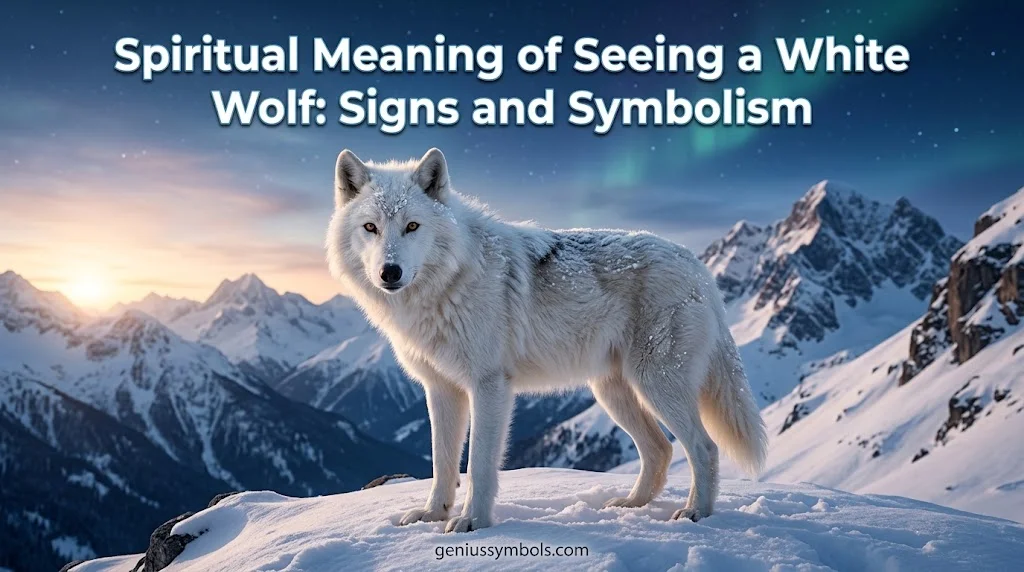
Have you ever seen a white wolf in a dream, a photograph, a movie, or even in the wild? Its pale coat and intense gaze can make the encounter feel unusual or deeply meaningful. For many people, the Spiritual Meaning of Seeing a White Wolf connects with intuition, inner strength, personal freedom, and a new stage of life.
In the United States, wolves often represent wilderness, loyalty, courage, and independence. However, a white wolf carries additional associations because white is commonly linked with purity, peace, clarity, and mystery. Together, these images create a powerful symbol that can feel both comforting and challenging.
Still, seeing a white wolf doesn’t automatically mean the universe is sending you a message. Its meaning depends on your beliefs, emotions, personal experiences, and the circumstances surrounding the encounter. Understanding its history and cultural associations can help you explore the symbolism without treating every coincidence as a prediction.
Quick Answer
The Spiritual Meaning of Seeing a White Wolf often represents intuition, independence, inner strength, and spiritual change. In American symbolism, it may suggest freedom, loyalty, and a connection with nature, while broader spiritual interpretations sometimes associate it with protection, wisdom, and guidance.
TL;DR
- Intuition: Trust your judgment while examining the facts.
- Strength: Face difficult situations with courage and patience.
- Independence: Protect your freedom without shutting others out.
- Loyalty: Value meaningful relationships and healthy boundaries.
- Transformation: Prepare for personal growth and changing priorities.
- Spiritual reflection: Explore what the encounter means within your own beliefs.
What Does a White Wolf Symbolize Spiritually?
A white wolf combines the natural qualities of a wolf with the symbolic meaning of its pale coat. For American readers, this image often brings together wilderness, purity, courage, and spiritual curiosity.
However, these meanings aren’t universal rules. Your personal beliefs and the setting of the encounter can change how you understand the symbol.
Intuition and Inner Wisdom
Wolves rely on their senses, awareness, and experience to survive. Spiritually, these qualities can represent learning to recognize your feelings without ignoring reason.
Seeing a white wolf might encourage you to pause before making an important decision. Consider whether you’re overlooking something your experience has already taught you.
Protection and Courage
A wolf can symbolize the courage to face uncertainty. Its presence may remind you to protect your values, respect your boundaries, and stand firm when necessary.
The white color adds a possible sense of peace or reassurance. Together, these qualities can represent strength guided by wisdom rather than aggression.
Purity and Transformation
White is often associated with fresh beginnings, clarity, and renewal in American culture. Therefore, a white wolf can represent leaving old habits behind while keeping the lessons they’ve taught you.
This interpretation may feel especially meaningful during a career change, a new relationship, or a period of personal growth.
Historical Origins of White Wolf Symbolism
Wolf symbolism reaches back thousands of years. Ancient people observed wolves in the landscape and included them in stories about survival, family, danger, and the relationship between humans and nature.
The specific idea of a white wolf as a spiritual messenger, however, doesn’t come from one single historical tradition.
Wolves in Ancient Mythology
In ancient Roman mythology, the she-wolf became associated with Romulus and Remus, the legendary founders of Rome. The animal’s role in their story connected the wolf with nurturing, survival, and the beginnings of a civilization.
In ancient Greek mythology, wolves also appeared in stories connected with gods, nature, and transformation. Their symbolism could be protective or threatening, depending on the story.
Norse mythology included wolves associated with powerful forces and the fate of the world. These traditions demonstrate that wolves have long represented more than one idea.
What Did the White Color Add?
White animals can stand out against darker surroundings, making them appear unusual or remarkable. In many symbolic systems, white also became associated with light, sacredness, innocence, or renewal.
However, historical sources don’t establish one universal ancient meaning for a white wolf. The modern spiritual image often combines broader wolf symbolism with the cultural meanings of white.
From Folklore to Modern Spirituality
European folklore frequently portrayed wolves as dangerous animals, especially in stories about forests and isolated villages. Fairy tales later reinforced images of wolves as threats, cunning predators, or figures that tested human judgment.
Over time, wildlife conservation, nature writing, photography, and modern fantasy helped present wolves in more varied ways. Today, a white wolf may appear as a symbol of wisdom, mystery, independence, or spiritual connection.
White Wolf Symbolism in American Culture
In the United States, wolves carry a complicated cultural history. They appear in Indigenous traditions, frontier stories, wildlife conservation debates, and popular entertainment.
Consequently, the spiritual meaning of a white wolf can reflect both admiration for wilderness and changing American attitudes toward predators.
Freedom and the American Wilderness
For many Americans, wolves evoke remote forests, snowy mountains, and wide-open landscapes. Their ability to survive in challenging environments makes them symbols of resilience and freedom.
A white wolf may represent the desire to escape daily pressures and reconnect with a more natural way of living. It can also symbolize independence without complete isolation.
Loyalty and Family
Real wolves are social animals that often live in family groups. Their cooperation and communication help them hunt, raise young, and maintain relationships.
These behaviors influence modern interpretations of wolves as symbols of loyalty and belonging. A white wolf can therefore represent balancing personal freedom with responsibility toward loved ones.
Native American Traditions and Cultural Respect
There is no single Native American interpretation of the wolf. Indigenous nations have distinct histories, languages, spiritual practices, and relationships with animals.
For example, Quileute traditions from coastal Washington include important wolf-related ancestral stories. Lakota cultural interpretations also connect wolves with qualities such as cooperation, observation, and wisdom.
These examples shouldn’t be treated as interchangeable beliefs or proof that every Indigenous nation regards a white wolf as a spirit guide. When exploring this symbolism, learn from the specific community whose tradition you’re discussing.
Why the Meaning Can Feel Different Today
Modern American culture presents wolves as both feared predators and admired symbols of wild nature. Conservation efforts and wildlife documentaries have also helped people understand their ecological importance.
As a result, the white wolf can suggest a relationship with nature, a desire for freedom, or a reminder to respect the balance between human activity and wildlife.
Read More: Spiritual Meaning of Seeing a Male and Female Cardinal Together
Spiritual Meaning of Seeing a White Wolf in Different Situations
The circumstances surrounding an encounter can shape its personal meaning. A peaceful wolf in a dream may inspire different feelings from an aggressive wolf or one standing alone in the snow.
Use the following interpretations as reflective possibilities rather than fixed predictions.
Seeing a White Wolf in the Wild
A real encounter may inspire awe, alertness, or respect for nature. Symbolically, you might connect it with paying attention to your surroundings or recognizing the beauty of something unfamiliar.
From a practical perspective, keep your distance from wild wolves. Don’t approach, feed, or attempt to follow one.
Seeing a White Wolf in a Picture
An image can attract your attention because of its color, expression, or setting. You might associate it with a quality you want to develop, such as courage, calmness, or independence.
Consider what first caught your eye. That detail may reveal more about your personal associations than a general symbolism guide.
Seeing a White Wolf Repeatedly
Repeated appearances in artwork, videos, or dreams may feel significant. However, once a symbol becomes important to you, you’re also more likely to notice it in everyday life.
You can use these moments as reminders to reflect on your priorities. There’s no reliable evidence that repeated white wolf imagery predicts a specific event or guarantees supernatural protection.
Seeing a White Wolf at Night
Nighttime can add mystery, uncertainty, and a sense of the unknown. A white wolf beneath moonlight may symbolize navigating a confusing situation while trying to preserve your sense of direction.
If the scene feels peaceful, you might connect it with patience. If it feels frightening, it may reflect uncertainty rather than danger ahead.
Emotional and Psychological Meaning of a White Wolf
Symbols often become meaningful because they connect with emotions, memories, and personal experiences. A white wolf can serve as a mental image for qualities you admire or challenges you’re trying to understand.
Psychology doesn’t require you to believe that an animal carries a supernatural message for the image to feel important.
Independence Without Loneliness
The wolf is frequently portrayed as a solitary creature, although real wolves are highly social. This contrast creates an interesting symbolic message about independence.
You may want more freedom while still valuing friendship and family. A white wolf can represent finding a balance between those needs.
Facing Fear and Uncertainty
A wolf’s sharp features and intense gaze can make it feel powerful or intimidating. However, its pale coat and snowy surroundings may soften that impression.
If you associate the image with courage, it might help you think about a difficult conversation or a decision you’ve been avoiding. The useful question isn’t whether the wolf predicts success, but what kind of courage your situation requires.
Personal Identity and Self-Discovery
Some people identify with wolves because they value loyalty, independence, or a strong connection with nature. Others connect with the animal because they feel different from those around them.
The white wolf may represent a wish to accept your individuality without losing meaningful relationships. Still, its symbolism doesn’t define your personality or determine your future.
White Wolf Symbolism Across Spiritual Traditions
Different cultures interpret wolves through their own histories, beliefs, and relationships with the natural world. Comparing these traditions can deepen your understanding, provided their meanings aren’t blended into one universal spiritual system.
Indigenous North American Perspectives
Some Indigenous traditions give wolves important roles in stories, ceremonies, teachings, and community identities. Depending on the nation, wolf imagery may relate to family, wisdom, transformation, or spiritual responsibilities.
These meanings belong to particular cultural contexts. It’s important not to claim that every Indigenous tradition teaches that seeing a white wolf means receiving a message from the spirit world.
European and Norse Traditions
European stories often portray wolves as complicated figures. They may represent danger, wilderness, loyalty, cunning, or powerful natural forces.
In Norse mythology, wolves have distinct roles within stories about gods and cosmic events. However, those stories don’t establish a universal spiritual meaning for encountering a white wolf today.
Contemporary Spiritual Interpretations
Modern spiritual writers sometimes describe a white wolf as a guide, guardian, or symbol of higher awareness. These interpretations commonly combine the wolf’s perceived strength with the symbolic associations of white.
You can explore these ideas within your own beliefs without assuming they represent ancient teachings shared by all cultures.
White Wolf Dreams and Their Possible Meanings
Dreams can combine memories, emotions, fears, and familiar images in unexpected ways. If a white wolf appears in your dream, its behavior and your emotional response may offer useful starting points for reflection.
There isn’t a scientifically established dictionary that gives every dream symbol one fixed meaning.
A Friendly White Wolf
A calm or friendly wolf might represent trust, confidence, or a desire for companionship. It could also reflect your appreciation for independence and strength.
Ask yourself whether you felt safe around the wolf. That feeling may help you understand what the image represents in your own life.
An Aggressive White Wolf
An aggressive wolf may bring up feelings of pressure, conflict, or vulnerability. Rather than predicting betrayal or an approaching threat, it may offer an opportunity to consider what currently makes you feel unsafe.
Think about whether the wolf was protecting something, chasing you, or simply standing its ground. These details can help you explore the dream’s emotional tone.
A White Wolf Walking Beside You
A wolf walking beside you may symbolize companionship, confidence, or the wish to trust your instincts. You might associate the scene with moving forward while staying connected to your values.
If you felt anxious, however, the same image could represent uncertainty about someone or something accompanying you through a difficult period.
A White Wolf Howling
A howl can suggest communication, belonging, distance, or the desire to be heard. In a dream, it might prompt you to think about a message you’ve struggled to express or a relationship that needs attention.
The interpretation depends on your experience, not on a guaranteed spiritual prediction.
Modern White Wolf Symbolism in Tattoos, Art, and Decor
White wolves remain popular in modern visual culture because their appearance combines dramatic contrast with a recognizable wild-animal form. Artists can use the image to express very different ideas through color, posture, and setting.
White Wolf Tattoos
A white wolf tattoo may express independence, resilience, loyalty, or a personal connection with wildlife. Some designs feature a moon, snowflakes, forests, or geometric patterns to add individual meaning.
Common design choices include:
- A realistic white wolf portrait representing strength and individuality.
- A wolf with a moon suggesting mystery and intuition.
- A wolf pack expressing family bonds and loyalty.
- A minimalist wolf outline representing simplicity and self-direction.
- A wolf surrounded by trees reflecting respect for wilderness.
Before choosing a design, consider whether its cultural references have specific meanings. A personal symbol can be powerful without borrowing sacred imagery from a community you don’t understand.
Home Decor and Artwork
White wolf paintings and sculptures often suit nature-inspired interiors. Their snowy colors can complement neutral walls, wood furniture, and mountain-themed decor.
A peaceful wolf image might create a sense of calm, while a close-up portrait can introduce a feeling of strength and intensity. The meaning depends partly on how the artwork makes you feel.
Social Media and Personal Expression
Online, wolf imagery can communicate independence, loyalty, resilience, or a preference for a solitary lifestyle. White versions may add associations with mystery, purity, or individuality.
However, an image doesn’t reveal someone’s complete personality or spiritual beliefs. Social media symbols are often chosen for their visual appeal as much as their meaning.
Misunderstandings and Controversies About White Wolf Symbolism
The white wolf can be a meaningful personal symbol, but not every claim about it has historical or scientific support. Understanding the difference between cultural tradition, personal belief, and established fact helps prevent confusion.
Is a White Wolf Always a Spiritual Sign?
No. A white wolf may be meaningful to someone because of their beliefs or life experiences, but an encounter doesn’t prove that a supernatural force is communicating with them.
White-coated wolves occur naturally. Their appearance can result from genetic variation and adaptation to their environment.
Does Every Culture Share the Same Meaning?
No. Claims that all Indigenous peoples, spiritual traditions, or ancient cultures regard white wolves as divine messengers oversimplify diverse histories.
A more respectful approach is to identify the specific tradition behind an interpretation. When no reliable source supports a claim, treat it as a modern personal belief rather than an established cultural fact.
Positive Symbolism and Harmful Appropriation
Wolf imagery is widely used in art, fashion, and personal expression. However, using sacred designs or presenting invented teachings as authentic Indigenous traditions can misrepresent the communities involved.
It’s also worth remembering that wolves are real animals, not just symbols. Romanticized images shouldn’t replace an understanding of their behavior, ecological role, and conservation needs.
How White Wolf Symbolism Has Changed Over Time
The wolf’s meaning has never been completely fixed. Its image has shifted as societies moved from close encounters with wild predators to folklore, conservation, entertainment, and personal spirituality.
From Threat to Symbol of Wilderness
In many European stories and American frontier accounts, wolves represented danger to people and livestock. Hunting and habitat loss contributed to major declines in wolf populations across parts of the United States.
Later conservation efforts and changing public attitudes helped many Americans see wolves as important members of healthy ecosystems. Today, admiration for their intelligence and social behavior exists alongside real concerns about livestock and wildlife management.
From Folklore to Popular Media
Books, films, games, and fantasy artwork have expanded the range of wolf characters. Some are dangerous, others loyal or protective, and still others are mysterious guides.
White wolves often stand out visually in these stories. Their unusual appearance makes them useful symbols of rare power, difference, or transformation, even when the story isn’t based on an established spiritual tradition.
What the White Wolf Means Today
In contemporary spirituality, the white wolf often represents a combination of familiar ideas: intuition, independence, loyalty, and renewal. These meanings reflect modern personal interpretation as much as historical tradition.
You don’t have to accept every interpretation to appreciate the image. Instead, consider which qualities connect with your experiences and values.
FAQs
Is seeing a white wolf good luck?
Some people interpret a white wolf as a positive symbol of strength, guidance, or new beginnings. However, there’s no reliable evidence that seeing one guarantees good luck or predicts a particular outcome.
What does a white wolf mean spiritually in a dream?
A white wolf in a dream may represent intuition, independence, fear, loyalty, or personal change. Your emotions during the dream and the wolf’s behavior can help you explore which interpretation feels relevant.
Does a white wolf represent protection?
In some modern spiritual interpretations, a white wolf symbolizes protection and courage. This is a symbolic belief rather than proof that an encounter provides supernatural protection.
What does it mean when a white wolf stares at you?
Symbolically, its gaze might suggest self-awareness, attention, or the need to examine a situation carefully. In a real wildlife encounter, a wolf’s gaze is animal behavior and shouldn’t automatically be interpreted as a personal message.
What does a white wolf symbolize in Native American culture?
There isn’t one meaning shared by all Native American nations. Specific traditions may connect wolves with ancestral stories, wisdom, cooperation, or spiritual responsibilities, but those meanings vary by community.
What does a white wolf tattoo mean?
A white wolf tattoo commonly represents independence, loyalty, courage, or a connection with nature. Its meaning depends on the design, the wearer’s intentions, and any cultural references included.
Conclusion
The Spiritual Meaning of Seeing a White Wolf often brings together intuition, courage, independence, loyalty, and transformation. In American culture, the wolf also represents the beauty and complexity of the wilderness, while the white coat adds associations with clarity, renewal, and mystery.
Ultimately, no single interpretation has to define your experience. If a white wolf catches your attention, consider what you were feeling, what changes you’re facing, and which qualities you want to strengthen in your life.

1 thought on “Spiritual Meaning of Seeing a White Wolf: Signs and Symbolism”